
OPERATION SINDOOR: INDIA’S THUNDEROUS RETRIBUTION AGAINST TERROR
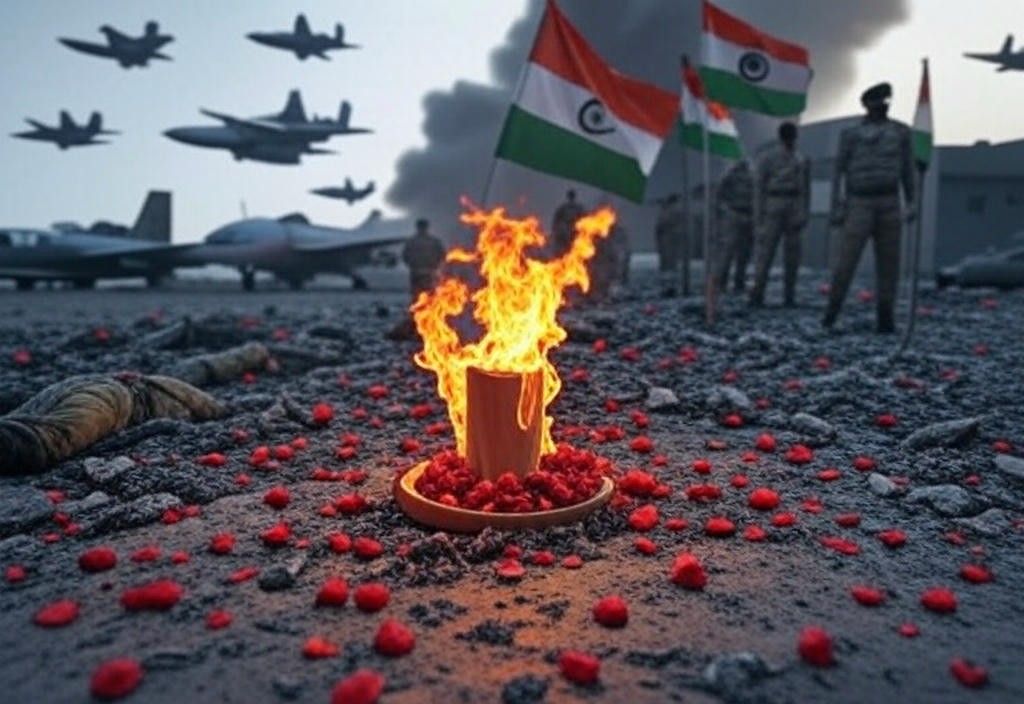
The Indian Armed Forces began campaign Sindoor, a carefully thought-out military campaign that targets terrorist infrastructure in Pakistan and Pakistan-occupied Jammu and Kashmir (PoJK), on May 7, 2025. One of India’s biggest cross-border attacks since the Balakot airstrikes in 2019, this operation was a direct reaction to the deadly Pahalgam terror incident on April 22, 2025, which killed 25 Indian people and one Nepali national. The operation emphasised India’s steadfast commitment to combating terrorism in addition to showcasing its military prowess.
Background: The Pahalgam Terror Attack
Lashkar-e-Taiba (LeT) terrorists trained in Pakistan carried out the Pahalgam attack, which was intended to disrupt the region’s return to normalcy by targeting tourists in Jammu and Kashmir. The picture of widow Himanshi Narwal kneeling next to her husband Lieutenant Vinay Narwal’s coffin became a moving representation of loss, and the fact that there was no “sindoor,” a customary sign of marital devotion, struck a deep chord throughout India. Prime Minister Narendra Modi personally gave the retaliatory expedition the moniker “Operation Sindoor,” which symbolises the widows’ personal sorrow as well as the country’s dedication to justice.
The Mission: Surgical Precision and Strategic Impact
On May 7, 2025, at around 1:05 AM, Operation Sindoor was initiated, and it was finished in 25 minutes at 1:30 AM. In a coordinated operation, the Indian Army, Navy, and Air Force launched 24 precision missile strikes against nine terror camps located in Pakistan and PoJK. The targets included localities like Bahawalpur, Muridke, Sialkot, Kotli, Ahmadpur Sharqia, Muzaffarabad, and Faisalabad that are home to proscribed terrorist organisations like Lashkar-e-Taiba (LeT), Jaish-e-Mohammed (JeM), and Hizbul Mujahideen.
Among the operation’s salient features were:
Precision Strikes: To make sure no Pakistani military installations were attacked, the Indian Air Force employed standoff and beyond-visual-range weaponry. This strategy maximised damage to terrorist infrastructure while reducing the likelihood of escalation.
Intelligence-Based Targets: The attacks targeted staging sites, weapons depots, command centres, and training camps, including those used by infamous terrorists like as David Headley and Ajmal Kasab.
Strategic Deception: Indian Air Force exercises close to the Rajasthan border were used as a distraction to keep Pakistan in the dark about the operation until the strikes started.
Result: UAV reconnaissance confirmed that all targeted sites were destroyed, and sources claim that the operation killed at least 17 terrorists and injured 60 more.
The strikes were “focused, measured, and non-escalatory,” according to the Indian Ministry of Defence, and they solely targeted terrorist infrastructure connected to operations against India.
Symbolic Significance
The term “Operation Sindoor” had significant emotional and cultural connotations. In addition to honouring the widows of the Pahalgam attack, especially those who lost their husbands, the operation’s name reaffirmed India’s dedication to safeguarding its people. Both grief and determination were evoked by the Indian Army’s official emblem, which showed a bowl of sindoor with a streak over the operation’s name.
Domestic and International Reactions
Domestic Support
“Operation Sindoor” has tremendous emotional and cultural connotations. The scarlet vermilion powder known as sindoor, which Hindu married women use, symbolises marital loyalty and the presence of a living husband. In addition to paying tribute to the Pahalgam assault widows, particularly those who lost their spouses, the operation’s name reiterated India’s commitment to protecting its citizens. The official insignia of the Indian Army, a bowl of *sindoor* with a streak over the operation’s name, emphasised both sorrow and resolve.
Support for Operation Sindoor was broad throughout India’s political spectrum. The military’s bravery and accuracy were commended by leaders of the Congress, Bharatiya Janata Party (BJP), and other parties. Congress President Mallikarjun Kharge referred to it as a “bold and decisive response,” while Manoj Tiwari, a BJP MP, emphasised the operation’s prudence by pointing out that no Pakistani civilians were hurt.
Global Reaction
Though varied, responses around the world tended to favour de-escalation calls. Former UK Prime Minister Rishi Sunak backed India’s measures, while Foreign Secretary David Lammy and Prime Minister Keir Starmer urged India and Pakistan to hold talks. To explain the purpose of the operation, Indian officials informed their counterparts in the US, UK, Saudi Arabia, UAE, and Russia.
However, Pakistan responded indignantly, saying the strikes killed eight people and injured 35 more. Independent fact-checkers refuted unverified reports of retaliatory missile strikes on India that were spread by Pakistani media and social media accounts. India insisted that its strikes were only directed at terrorist targets, but Pakistan pledged reprisal and blocked its airspace for 48 hours.
Strategic Consequences
An important development in India’s counterterrorism strategy was Operation Sindoor. During a press briefing, Colonel Sofiya Qureshi stated that the operation was intended to destroy decades-old militant infrastructure in Pakistan and PoJK, indicating a move towards preemptive strikes. India has zero tolerance for cross-border terrorism, which is further supported by Foreign Secretary Vikram Misri’s description of Pakistan as a “haven for terrorists.”
There were ramifications for domestic security as well. In order to guarantee readiness, civil defence exercises under “Operation Abhyaas” were held all over the country, and Union Home Minister Amit Shah urged border states to maintain their vigilance. In response to increased tensions, airlines including SpiceJet temporarily suspended commercial flights to Jammu and Kashmir, Ladakh, and other northern territories until May 10, 2025.
Conclusion
Operation Sindoor is evidence of India’s determination to fight terrorism effectively and precisely. In addition to exacting revenge for the Pahalgam incident, India made it very evident that there is no safe haven for those who would jeopardise its sovereignty by attacking nine terror camps in Pakistan and PoJK. Because of its emotional and cultural resonance, the operation’s symbolic name highlighted the stakes on both a personal and national level. Operation Sindoor, which strikes a balance between immediate action and strategic patience, will probably be recognised as a pivotal milestone in India’s war against terrorism as it navigates the geopolitical ramifications.
Comments 0